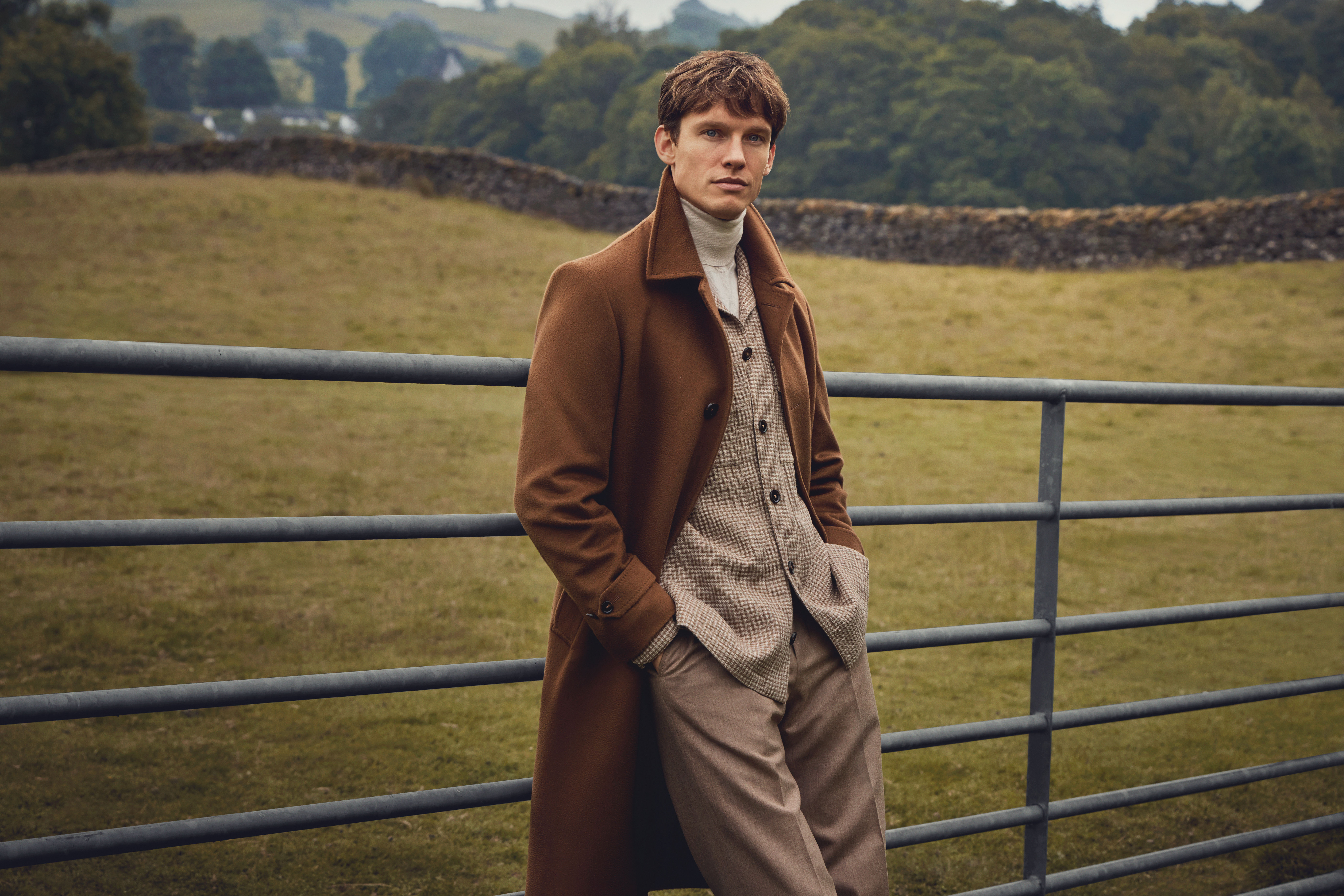
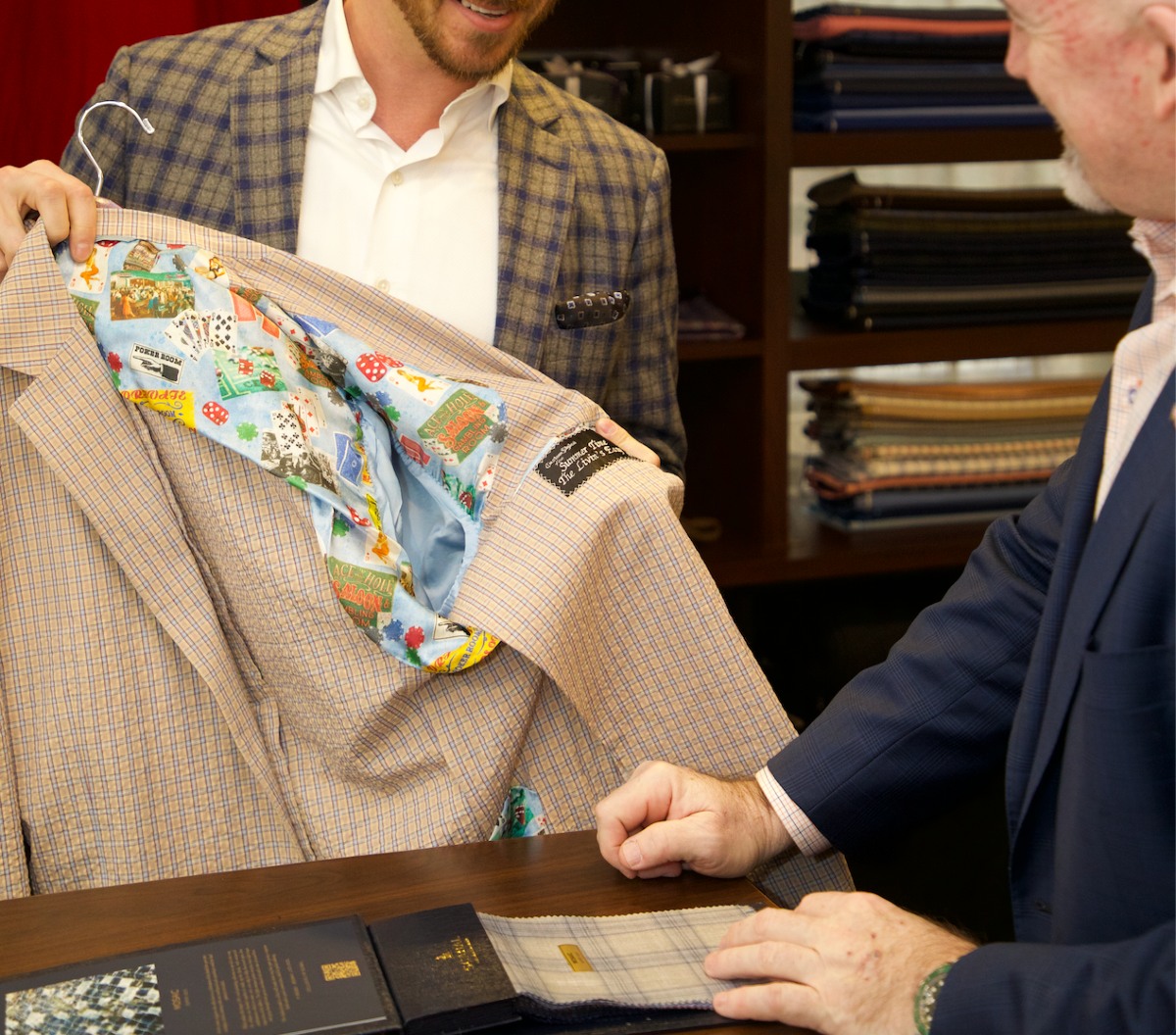
There is a phrase that is bandied about in the clothing business, usually delivered with a small apologetic sigh, about certain men being “hard to fit.” We have never cared for it. A man is not hard to fit just because a rack of ready-to-wear fails to fit him.
We have been measuring men in Philadelphia since 2006, and a larger gentleman is not a puzzle to us. He is, if anything, the client for whom the work matters most. A trim 34-year-old in a size 40 can wander into a department store, buy something reasonable off the peg, and look acceptable by accident. This is not the same for a stocky or tall man whom mass retailers choose to ignore.
Everything a larger man wears must be deliberate lest he risk a disaster. That is inconvenient, but it is also a kind of freedom: once you accept that your clothes must be chosen on purpose, you tend to end up better dressed than the men who never had to think about it.
What follows is not a list of things to hide. It is how proportion actually works, and a guide on how to dress the body you have.
The Drop, and why it does not care about you
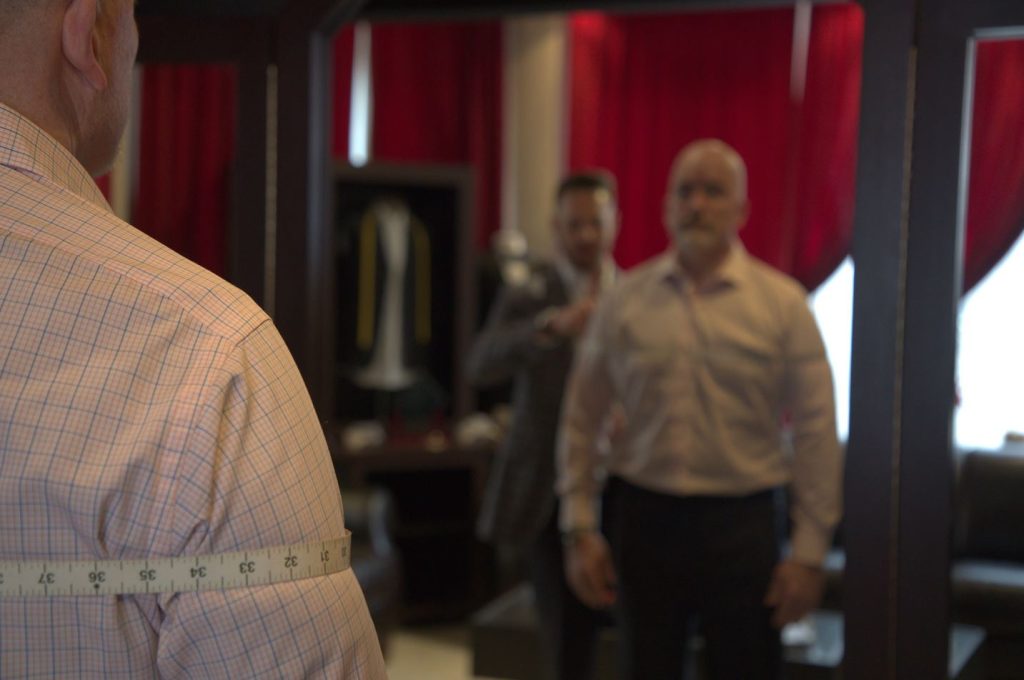
Every suit made for a rack is constructed on an assumption called the drop: the difference in inches between the chest and the waist. The industry standard hovers around six or seven inches. A 46 jacket presumes a man with roughly a 40-inch waist, and the pattern is cut on that faith.
Plenty of men do not live there. A man with a 46-inch chest and a 46-inch waist has a drop of zero. He is not unusual but conspicuously not catered to in the market. To get a jacket that closes over his middle, he has to size up, and the moment he does, the shoulders arrive built for a man four inches broader than he is. The shoulder line overhangs. The armhole sinks toward the ribs, so raising his arm drags the whole jacket with it. The back balloons. The sleeve runs long. He looks, in the fitting room mirror, like a man wearing his older brother’s suit, and he concludes that the problem is his body.
The problem is the pattern. Almost everything on a jacket can be adjusted after the fact. The shoulder is the one thing that cannot be meaningfully rebuilt, which is why sizing up to accommodate the waist is the single most common and most costly mistake a larger man makes. If you take one thing from this piece, never buy a shoulder you do not need.

Length Is Not A Style Preference
Short jackets have been in vogue as of recently, but for a fuller build, they can be a catastrophe.
A jacket that stops above the seat cuts the body horizontally at or near its widest point and leaves the trouser seat announcing itself underneath. You now have two blocks stacked on each other, and the eye reads two wide things instead of one long thing. A jacket cut to cover the seat, with the hem landing around the second knuckle of a relaxed hand, does the opposite: it draws one uninterrupted vertical line from shoulder to thigh, and it lets the leg emerge below rather than the middle emerging above.
Length is not fashion. It is performed on your silhouette, and it is worth more to you than almost any other detail on the garment.
The V Does Most Of The Work
The open wedge of shirt and tie between the lapels is the most useful shape available to a bigger man, because it is a vertical arrow pointed at his face.
A lower button stance lengthens that V. A generous lapel, in the neighborhood of three and a half inches, sits in proportion to a broad chest, where a skinny lapel only advertises how much chest there is on either side of it. Slightly open quarters let the front of the jacket fall away from the stomach instead of straining against it. Gentle waist suppression, not none, gives the garment a shape; a jacket cut as a straight tube reads as a barrel, every time.
And then there is the double-breasted, which the larger man has been told for decades he cannot wear. He has been told wrong. A double-breasted jacket has a naturally low stance, a long clean diagonal across the front, and a wrapped closure that lies flat over the midsection rather than pulling at a single button. On the right frame, it is the most flattering thing in tailoring. If you want the mechanics, we wrote them up in The Difference Between Single & Double Breasted Suits.
Where The Trousers Sit Is The Whole Ballgame
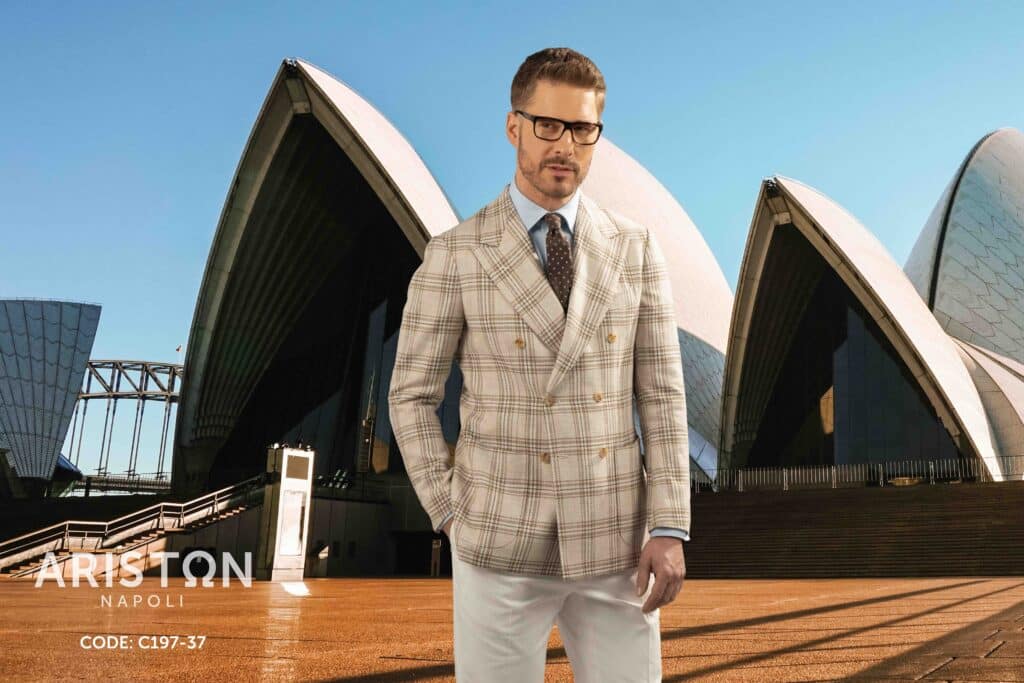
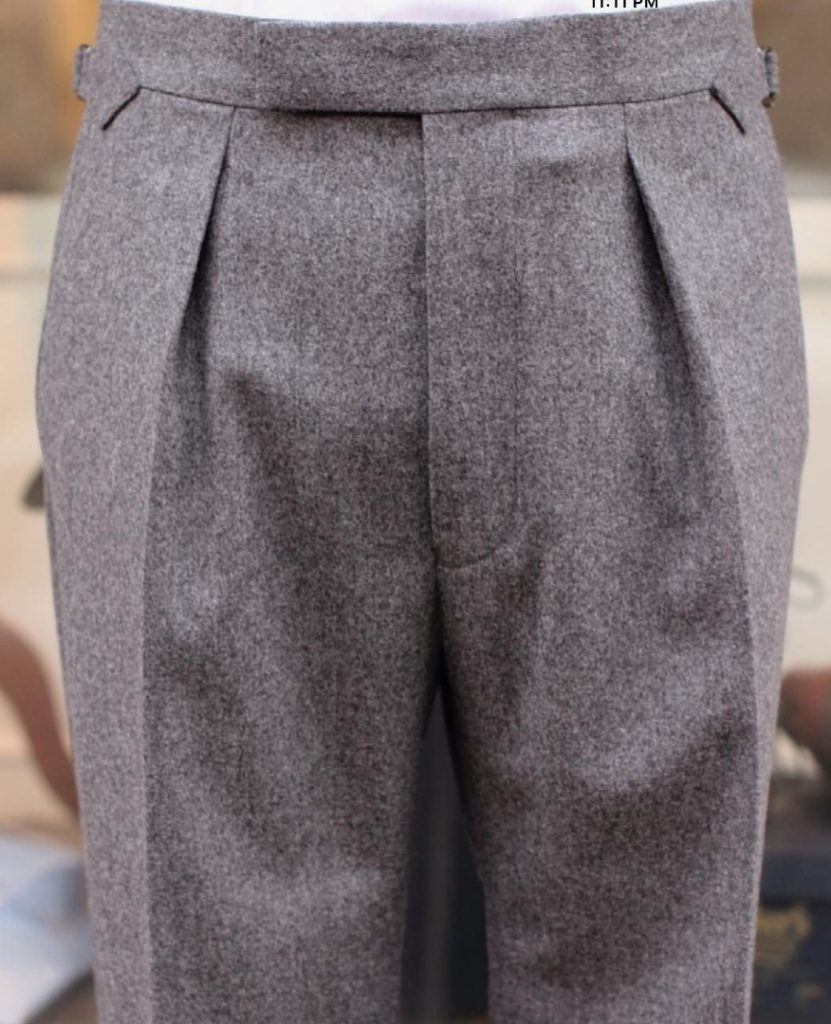
If the jacket is half the battle, the trousers are the other half, and rise is where it is won or lost.
Low-rise trousers sit below the stomach. This does two unhelpful things at once: it turns the midsection into a shelf resting on the waistband, and it shortens the visible leg, because the leg now begins several inches lower than it actually does. A higher rise, sitting at or near the natural waist, smooths the front and gives back every one of those inches as leg. Men are frequently astonished by how much taller a properly risen trouser makes them look. We covered the concept, and the widespread confusion about where a waist even is, in What Is Rise?.
Three companions to that:
Pleats. A forward pleat gives the front of the trouser room to move, so the cloth hangs from the waistband instead of stretching across the thigh and pulling the pockets open. Flat fronts are lovely on men who have room to spare. If you don’t, pleats are not a concession, they are engineering.
Braces. A belt cinches, and cinching creates a horizontal line exactly where you would rather not draw one. Braces suspend the trouser from the shoulders, hold the rise where it belongs without compression, and let the waistband sit at its true measurement rather than a hopeful one.
The leg and the hem. A trouser that tapers hard to a narrow hem sets a wide top over a pin, which is the inverted-triangle effect nobody is going for. A straight or lightly tapered leg with enough width at the shoe balances the upper body, and a slight break keeps the line unbroken to the floor. Point Break: A Lesson on Pant Length has the details.
Cloth That Drapes Rather Than Reports
Fabric behaves differently on a fuller frame, and this is where a great deal of money gets wasted.
Thin, slick, high-twist cloth clings and reports every contour underneath it. Cloth with some weight and body, a 12 or 13 ounce worsted, a flannel, a hopsack, hangs away from the body and holds its own shape. That is drape, and drape is a bigger man’s best friend. Matte finishes absorb light; high-shine finishes bounce it off every curve. Texture beats sheen. See A Brief Guide to Cloth Weights and The Different Kinds of Flannels.
Construction matters here too. A canvassed chest piece is shaped with the body and molds further with wear. A fused one is a flat plane glued to cloth, and a flat plane laid over a rounded chest will bubble and fight back. What Is Canvas in a Suit Jacket? explains the difference, and How to Tell if a Suit Is High Quality covers what else to look for.

One Column, Not Three
The old advice about vertical stripes is folklore, and mostly overstated. What actually works is contrast control.
When the jacket and trouser sit close in tone, the eye reads one long column. When a dark jacket meets a light trouser, the eye reads a break, and a break at the waist is the one place you do not want the viewer to stop. This is a matter of degree, not a prohibition: a navy jacket over mid-grey flannel is fine, a black jacket over cream is a horizontal line drawn in marker. What Is Contrast in Menswear? and Fundamentals of Color Coordination go deeper, and if you enjoy pattern, Pattern Mixing 101 applies without modification. Scale is the only adjustment: a larger frame carries a larger check or stripe comfortably, where a micro-pattern can read as noise.
The Collar Is A Frame
Shirts get overlooked, which is strange, since the shirt collar is the only thing on you that touches your face.
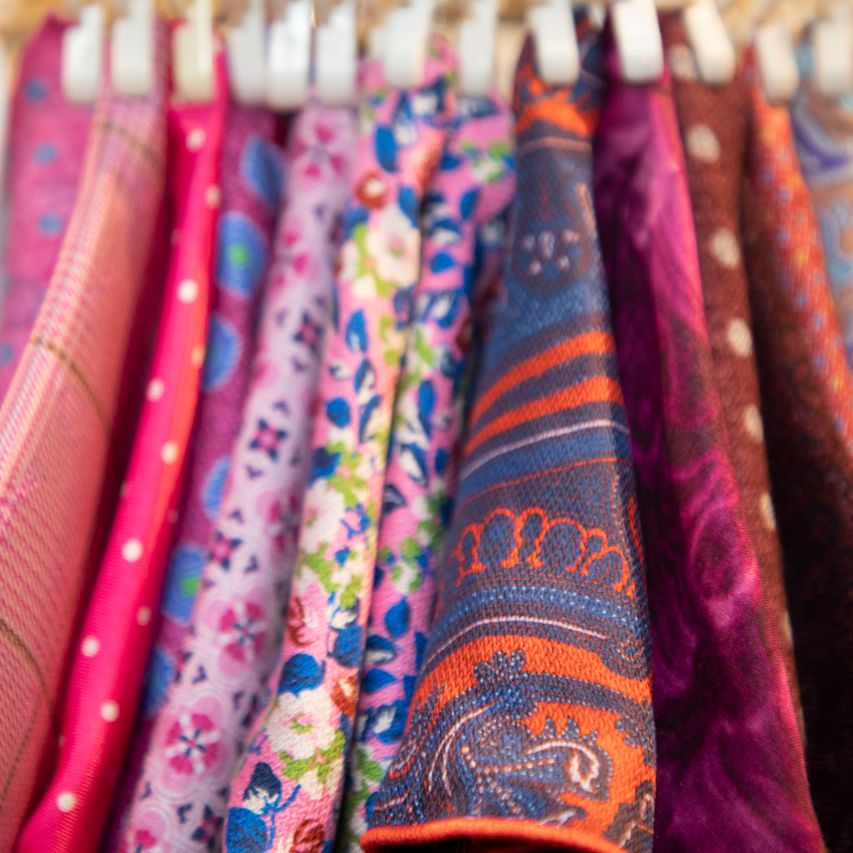
A broader neck and a fuller face need a collar with presence: adequate point length, a semi-spread or spread, a band tall enough not to disappear. A small, short point collar on a large man makes his head look like an afterthought. Ready-made shirts in bigger sizes also tend to be cut as tents, with acres of fabric billowing at the waist and armholes cut nearly to the elbow. A shirt shaped through the torso with a high armhole moves better and looks considerably trimmer, without ever being tight. The Dress Shirt Compendium is our full treatment.

The Point Of All Of It
None of this is about looking smaller. It is about looking correct, which is a different and far more achievable goal, and one that has nothing to do with the number on the tape.
Clothing that fits reads as confidence, because a man who is not adjusting, tugging, or bracing against his own jacket has attention left over for the room. That is the entire trick. The larger man who has taken the time to understand rise and length and drape tends to walk into a room better turned out than everyone who never had to learn.
If you would like to talk any of this through, or see what your own proportions actually call for, we are always happy to talk about clothes. You can reach us at 215-310-0219 or info@henrydavidsen.com, and the custom clothing process is laid out here if you would rather read first.