
Almost every groom who calls us opens the same way: “Am I too early?”
Almost nobody is. In twenty years of dressing grooms in Philadelphia, we have taken far more calls from men who waited than from men who planned. So here is the honest answer, the one we would give you across the table in our showroom rather than the one that makes for a tidy headline.
Count backward from the day the garment needs to be in your hands, not from your wedding day. Made-to-measure runs six to eight weeks. Bespoke runs twelve to fourteen. And the right time to actually start the conversation is three to five months out.
Those two sets of numbers are different on purpose, and the gap between them is where most of this article lives.
Production timelines VS Planning timelines
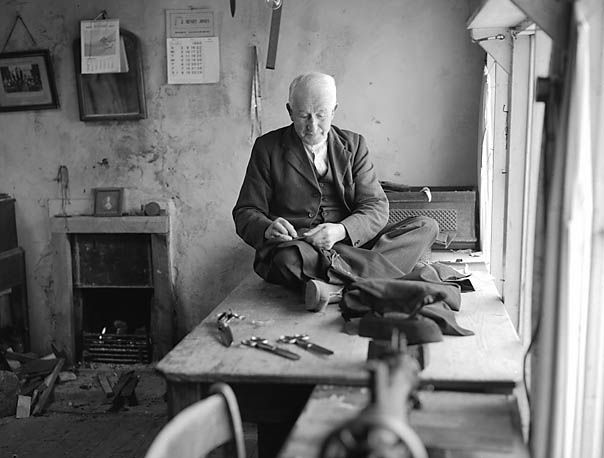
Production time is a manufacturing fact. Cloth gets ordered, a pattern gets cut, a garment gets made, and it ships. For made-to-measure, that is six to eight weeks. For bespoke, where a pattern is drafted for you from scratch and the garment is built through basted fittings, that is twelve to fourteen weeks.
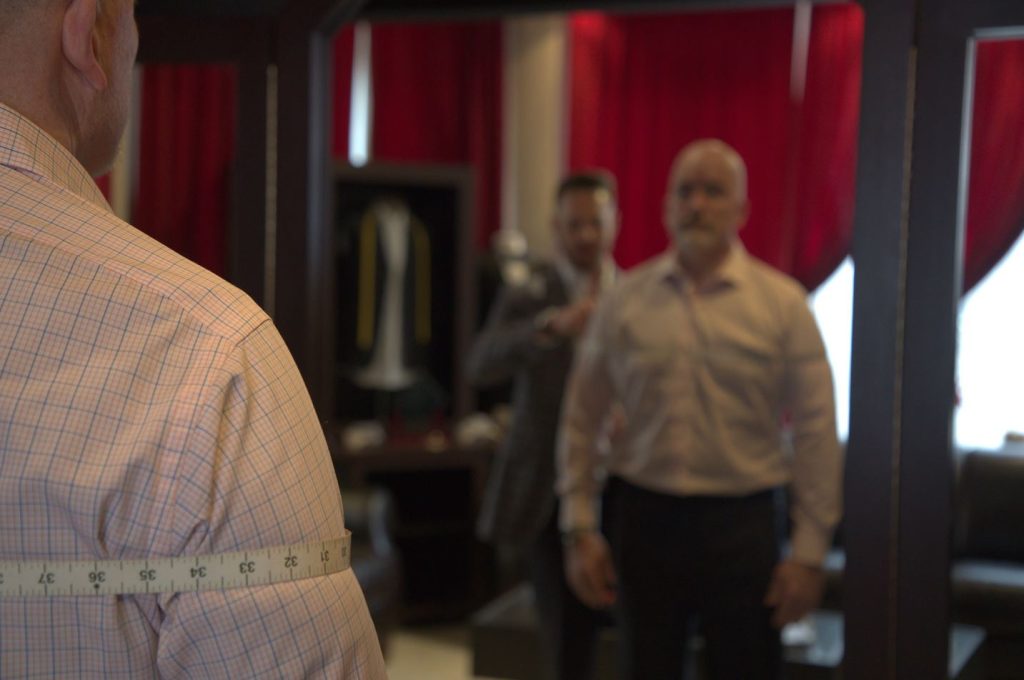
Planning time is everything around it. That includes the consultation, the cloth decision, your measurement appointment, the fitting after the garment arrives, the alterations that follow the fitting, and the very real possibility that you look at yourself in the mirror at the first fitting and decide you want a different lapel. It also includes the part nobody puts on a schedule, which is life. Work travel. A venue change. A fiancée who decides in month seven that the color palette is now sage.
Three to five months gives you room for all of it. Six weeks gives you a deadline.
Why Three - Five & Not Twelve?
We are not going to tell you that earlier is always better, because with custom clothing it is not.
Most grooms are trying to change their bodies before the wedding. That is not a criticism, it is just what happens when you know several hundred people are going to look at you and a photographer is going to make it permanent. Men train, they cut weight, they get serious about the gym in a way they have not been since college.
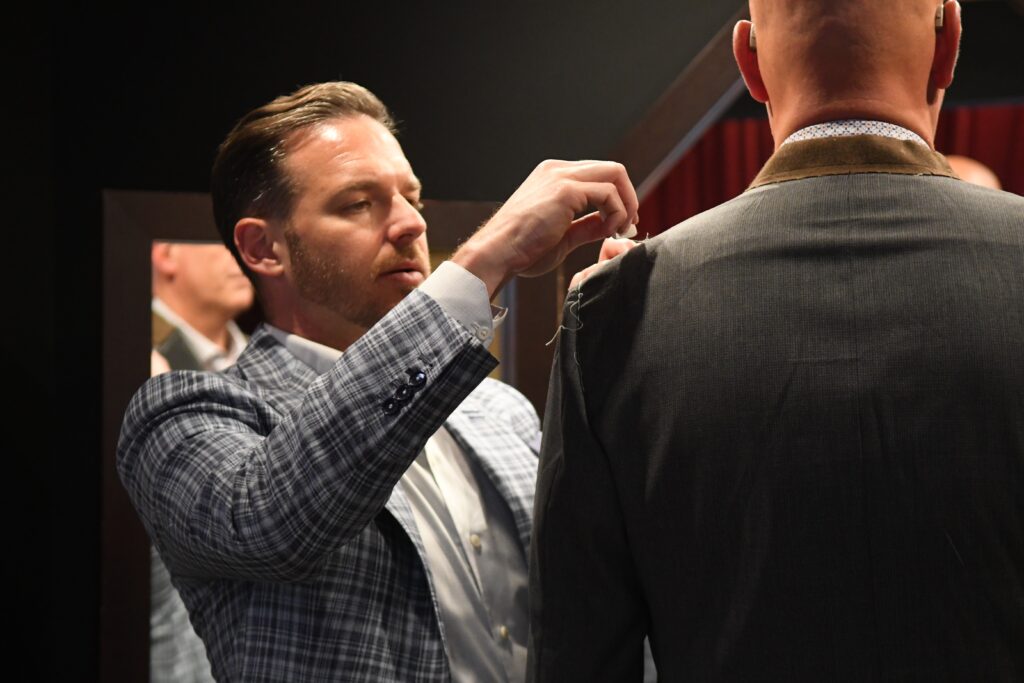
A custom garment is built to the body that walks into the showroom. If we measure you eleven months out and you drop twenty pounds in the interim, we are not making small adjustments, we are rebuilding the garment. Chest, waist, shoulder, and sleeve all move. A jacket can be taken in only so far before the balance of the garment is gone and it stops looking like it was made for you, which defeats the entire purpose.
Three to five months is the sweet spot. It is long enough to work unhurried and short enough that your body is roughly the body that will show up on the day. If you are in the middle of a significant transformation, tell us at the consultation. We will build the schedule around where you expect to land, and we will time your measurement appointment accordingly rather than pretending the variable does not exist.
If your wedding is fourteen months away, we are still glad to talk. We will simply tell you when to come back, and we will use the time in between to sort out the questions that do not depend on your measurements, like whether you should be in a tuxedo or a suit in the first place.

"In your hands" means in your hands
This is the part that trips up otherwise well-organized men.
Your wedding is on a Saturday. Your garment does not need to exist on Saturday. It needs to exist in your closet, altered and pressed, well before that, and the number of days between those two points is larger than you think.
Work backward through the real sequence. There is the rehearsal dinner the night before, which for many of our clients means a second outfit. There are the first-look photographs, which happen hours before the ceremony. There is the final fitting, which we schedule roughly two weeks out so that any last adjustment can be made without drama. And if you are flying, your garment needs to be packed, which means it needs to be finished and in your possession days before you leave, not the morning of.
For a destination wedding, add more. We ship anywhere, and we do it regularly, but customs, carriers, and resort front desks are not part of our workshop and we cannot control them. When a groom tells us the wedding is in Positano or Cabo or Tulum, we add several weeks to the front of the schedule and we deliver to him here in Philadelphia so the garment travels with him. A suit in your garment bag is a suit you have. A suit in transit is a hope.
The rule we give clients is simple. Pick the date the clothing needs to be physically in your hands, then count backward six to eight weeks for made-to-measure or twelve to fourteen for bespoke. That is your true deadline. Then give yourself another month on top of it for the consultation and the decisions. Now you have a start date.
What happens if you are already behind
Sometimes the call comes in April for a June wedding. It happens more than you would guess, usually because somebody else dropped the ball, and it is not a conversation we approach with judgment.
We have three honest options, and we will tell you which one is right for you rather than which one is most profitable for us.
We build it on the normal timeline if it fits. Sometimes the math works better than the groom expected, particularly for made-to-measure. Before we discuss anything else, we check.
We use a rush program. Our mills and workshops can move faster when we ask them to, but there are real costs. Rush carries a significant fee. It narrows your cloth options considerably, because we can only work with what is physically in stock and ready to cut. And it limits customization, since many of the details that make a bespoke garment yours are precisely the details that take time. A rush garment is still a very good garment. It is simply a garment with fewer of your fingerprints on it.
We tell you to buy off-the-rack. If you are inside a window where custom would mean compromising the fit or the outcome, we will say so in the consultation and point you toward a better path. We would rather be the people who told you the truth in March than the people who handed you something rushed in June. Grooms remember which one you were, and so do their friends.
What we will not do is let the date pass. We have never missed a wedding, and yours is not going to be the first. That is not a slogan, it is a production commitment we make internally and plan around, and it is the reason we are conservative with timelines in the first place. The padding is not for us. It is for you.

What the first conversation actually looks like
The consultation is not a fitting and it is not a sales appointment. It is a planning session.
We will ask what your venue is, what time of day the ceremony is, what the season and the climate will be, what your fiancée is wearing, and what the rest of the wedding party is doing. We will ask whether you want a garment you will wear again, because the answer changes the recommendation substantially. A midnight blue dinner jacket lives a long life after the wedding. A traditional ivory jacket for a beach ceremony probably does not, and that is fine as long as you decide it on purpose.
From there we map the calendar backward, choose a lane, and select cloth appropriate to the season and the venue. A heavy worsted in a Charleston summer is a decision you will feel all night. If you want a fuller picture before you come in, our groom’s guide covers the territory, and if you are marrying in October or November in this city, our guide to Philadelphia fall weddings is more specific still. For budget, we have written plainly about what custom wedding suits cost in Philadelphia.
We are not trying to sell you the most expensive thing in the room. We are trying to be the person in your corner who has done this many times before and can tell you what matters and what does not.